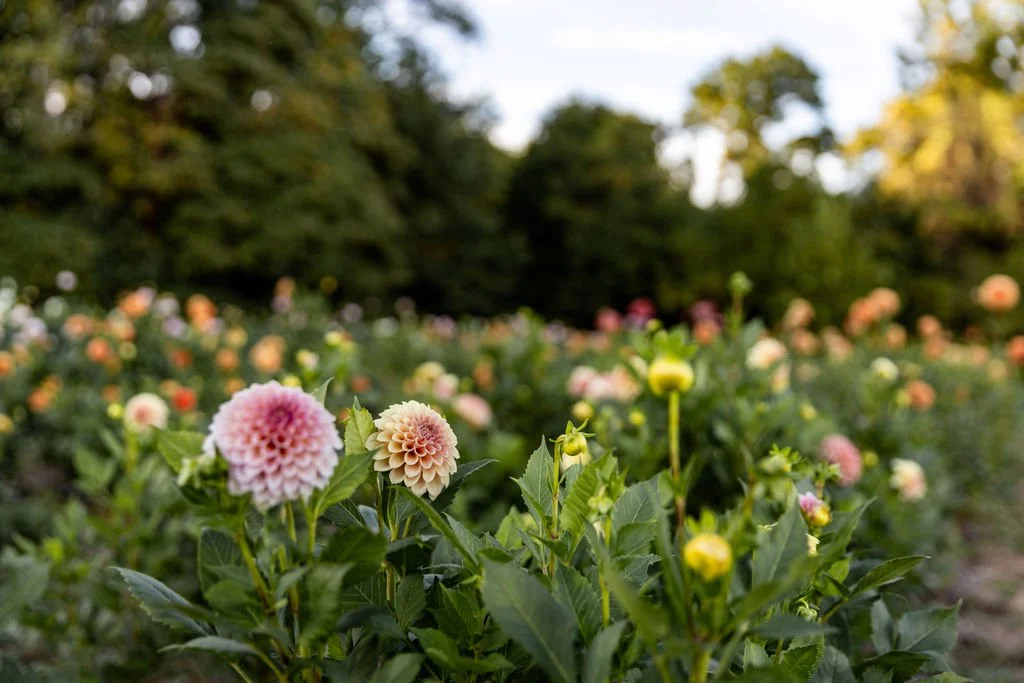
Overwintering Dahlias in the Ground
A few years ago, I shared our experience overwintering dahlia tubers in the ground here in Zone 6 in southwest Michigan. Since then, I have continued overwintering dahlias in place each year, refining the process to work on a larger scale while keeping the same core approach. This post shares what that looks like now and what I have learned along the way.
The general process is to cut the dahlias back to about 1 to 2 inches. This year, I did not leave the stalks in the rows. Instead, they were moved into a pile on the side of the field to eventually turn into compost. After cutting back, the area is topped with leaves, then covered with a tarp and secured.
I started this process at the beginning of October and continued over a couple of weeks as the last rows were taken out by frost. I often hear that you need to wait until frost before doing anything, but that has not been my experience. As long as the tubers have been in the ground for roughly 12 to 16 weeks, they have what they need to be productive the following year.
This year, we needed to cover an area about 60 by 80 feet. That includes the growing rows, the walking paths between them, and a few extra feet around the perimeter for a buffer.
I used a mix of mulched leaves and whole leaves collected from our property, along with a trailer load dropped off by a local landscaper. There were moments when I did not think we would have enough, and I had to remind myself that some coverage is better than none. In the end, we ended up with roughly nine to twelve inches of leaves over each row, with some spilling into the paths.
In past years, I have aimed to cover the entire area with at least twelve inches, but I was not able to do that this season. I do not think this will be an issue. Later, when I listened to Jennie Love on the No Till Flowers Podcast mention that they no longer tarp their paths at all, it gave me some reassurance that this approach should be just fine. More on that in a bit.
A big change I made this year was switching to two large tarps that overlap slightly in the center, instead of using multiple old billboard tarps like I had in the past. I made this decision so there would be fewer seams that needed to be weighted down.
The tradeoff is that larger tarps are much heavier. I needed help picking them up from the store and also recruited help to lay them out in the field. With one other person, though, we were able to get it done without much hassle. I made sure to wait for a calm day. I would not recommend attempting this with any wind.
We laid the tarps out and secured them with cement blocks we already had on hand. Blocks were placed around the edges and along the center seam every two to three feet. Once everything was set, the field felt settled and protected going into winter.
The primary goal of this process is to keep the tubers dry. In our winter climate, wet tubers often mean frozen tubers, which then turn to mush as they thaw and are no longer viable. Another goal is to treat dahlias more like perennials rather than annuals.
In their native environment, dahlias are not annual plants. The tubers live underground year round, and this approach more closely mimics that natural cycle. Leaving the tubers in place does not disturb the soil around them and gives them a chance to settle in, much like other perennial plants. It brings to mind the familiar saying about perennials: first year sleep, second year creep, third year leap.
This is where I want to point you to the No Till Flowers Podcast, Episode 46: Overwintering Dahlias in the Ground, Zones 5 and Warmer. Jennie gives a great explanation of the science behind why overwintering in place can be beneficial. In short, leaving organic matter in place mimics what happens naturally. Plants drop leaves, roots stay put, and the soil is never left bare. That layer acts as both insulation and food. Healthier soil leads to stronger tubers, more vigorous spring growth, and plants that are better able to handle stress during the growing season.
One change I plan to make next year is adding amendments in the fall, after cutting down the plants but before adding leaves or mulch. This was on my mind this year, but I never quite got around to it. Because of that, I will need to pull the leaves back a bit in spring to add what we need. Lime, in particular, is a must.
Overwintering dahlias in the ground is not about cutting corners. It is about understanding how soil works and trusting that plants benefit when we stop disrupting them unnecessarily.